What In The Non Whimsical Fuckery Is Going On With Reading?

The "Behind Benchmark" Smoke Screen: Why School Staff Get So Defensive When Your Kid Can't Read
The email arrives on a Tuesday afternoon. It’s brief, polite, and completely paralyzing.
“Just a quick update: Your child is currently trailing behind peer benchmarks in reading fluency. We are working on it in class, but please make sure you are reading together for 20 minutes every night at home!”
You stare at the screen, a knot forming in your stomach. No breakdown of why they are behind. No mention of specific phonetic gaps. No actionable roadmap. Just a vague warning and a directive to "read more"—which, at this point, feels like being told to fix a broken car engine by just turning the key harder.
But when you push for specifics—when you request a formal meeting or question the methods being used—the tone shifts. The polite vagueness doesn't turn angry; it transforms into a highly sophisticated wall of institutional deflection, passive-aggressive comparison, and educational jargon.
Why does asking simple questions about your child's literacy feel like hitting a bureaucratic fortress? Let’s pull back the curtain on the institutional machinery, look at how these meetings inadvertently escalate, and scientifically dissect what is actually breaking down inside the reading brain.

Phase 1: The Classroom Meeting (The Sweet Trap)
When you first try to pin down the exact mechanical breakdown of why your child is stuck, you often meet a wall of overwhelming sweetness and bright positivity. The teacher isn't trying to fight you—she genuinely cares—but she is trapped in a specific framework. To a worried parent, however, this unyielding optimism can feel a lot like gaslighting, causing defenses to go up on both sides.
Parent: "Thanks for taking the time to sit down. I looked over the tracker, and she's completely shutting down on words with basic consonant clusters like st- or pl-. Can we look at the specific phonics intervention she's getting during the day?"
Teacher: "Oh, she is just an absolute joy to have in class! Truly, her energy lights up the room. In first grade, it’s really more about stamina and immersive text exposure. She gets a little distracted during independent reading time because she loves looking at the gorgeous pictures! It's totally age-appropriate."
Parent:(Feeling the first spike of defensive anxiety) "Right, but she’s looking at the pictures because she can't decode the text. If she can't sound out a basic CVCC word, she’s going to distract herself. What explicit phonics curriculum are we using to bridge that?"
Teacher:(The bright smile stays perfectly locked in place) "Our curriculum is incredibly rich, balanced, and literature-centered, and the rest of our standard reading groups are navigating the modules beautifully this term! Honestly, what we really love to see is more support from home. If you can just make sure you're hitting that cozy 20-minute nightly reading window together, she’ll build that same classroom stamina!"
The Hidden Perspectives:
How the Parent Perceives It:She’s implying I’m failing at home. She’s completely ignoring the fact that my kid is drowning, and she’s subtly telling me my child is the problem because the other kids are "navigating it beautifully."
What the Teacher is Actually Thinking:I have twenty-two other children in this room, five of whom have severe behavioral disruptions, and I am mandated to use a curriculum the district bought. This parent is hyper-focusing on isolated phonics drills, and if I admit the district's balanced literacy framework has holes, I’m opening a massive can of worms I don't have the authority to fix.
Phase 2: The Specialist Wall (The Bureaucratic Escalation)
Because the classroom teacher couldn't give you a straight answer, you push for an escalation. You find yourself sitting across from the school's reading or RTI (Response to Intervention) specialist. Because you are already feeling defensive from the first meeting, your tone is sharper. The specialist senses this instantly and retreats into institutional armor.
Parent: "I’ve been tracking her errors at home. When she sees an unfamiliar word, she instantly looks at the picture and guesses, or she just throws out a word that starts with the same letter. She isn't looking at the whole word because she hasn't been taught to decode sequentially. We need a different approach."
Reading Specialist: "We use a multi-tiered system of support here. Our benchmarking tools—like our universal screeners—measure multi-contextual fluency and holistic literacy acquisition. The strategic interventions we implement are deeply rooted in differentiated, literature-rich immersion."
Parent:(Frustration boiling over) "Differentiated immersion isn't teaching her how to blend a consonant cluster. Is she being taught explicit, systematic phonics, or is she being told to guess based on context clues?"
Reading Specialist:(Tone flattening into clinical distance) "Our methods utilize research-validated, state-approved frameworks. Children develop across a highly individualized continuum, and introducing rigid drills too early can actually disrupt natural text comprehension. We are treating the whole child, and our metrics show our cohort is pacing quite well overall."
The Hidden Perspectives:
How the Parent Perceives It:They are burying me in vocabulary to make me feel stupid and go away. They are protecting their methods over my daughter’s future.
What the Specialist is Actually Thinking:This parent is becoming combative and questioning my professional credentials. They’ve clearly been reading articles online about the 'Science of Reading' and are trying to dictate clinical interventions without understanding our master schedule, our data tracking systems, or state compliance.
Phase 3: The Administration Gatekeepers (The Compliance Shield)
By the time you reach the principal’s office, the situation has inadvertently escalated into a turf war. You are fighting for your child's mind; the administration is fighting to maintain control of their building, their budget, and their legal liability.
Parent: "The current intervention isn't working. Her tracking data hasn't moved in three months. I want her placed in an explicit, systematic phonics program, and I want an immediate evaluation for an IEP."
Principal: "Our current Tier 2 intervention is fully compliant with state standards and district protocols. We cannot simply jump to specialized evaluations because a parent is anxious about home reading performance."
Parent: "It’s not 'anxiety.' It’s a documented lack of progress based on your own universal screeners. She is drowning under the cognitive load of the books you are sending home."
Principal: "The school has a specific protocol for data collection, and we determine the timeline for evaluations based on targeted matrix metrics. If you choose to bring in outside materials, that is your prerogative, but we will continue to measure her progress according to our district-mandated benchmarks."
The Hidden Perspectives:
How the Parent Perceives It:They don't care. It’s a cold, bureaucratic machine, and they are actively blocking me from getting my child the help she needs.
What the Principal is Actually Thinking:If I approve an IEP evaluation based on a parent demand outside of our data timeline, I set a precedent that blows our special education budget. Furthermore, if I validate this parent's claim that our standard curriculum is failing, I risk a district-level liability issue. I have to protect the school's structural boundaries.
The History: How Did We Get Here?

To understand why the school's response is so fiercely defensive, you have to understand the history of American literacy instruction. For decades, a massive chunk of school districts fell under the spell of a philosophy called Whole Language or Balanced Literacy.
The core belief was romantic but dangerously flawed: it posited that learning to read is a natural process, just like learning to speak. Proponents argued that if you just immerse children in beautiful, rich text environments, their brains will naturally deduce how to read. Instead of teaching children to systematically crack the phonetic code from left to right, classrooms taught the "Three-Cueing System," explicitly training children to look at an unfamiliar word and guess it using context, pictures, or just the first letter.
The National Assessment of Educational Progress (NAEP)—the Nation’s Report Card—has consistently shown that this guessing-game experiment resulted in a massive national literacy crisis, leaving a staggering percentage of elementary students performing below basic proficiency levels.
The Science: Dissecting the Root Problem

When a school throws heavy educational jargon at you, you can confidently stand your ground because cognitive science and neuroscience have completely debunked Balanced Literacy. The true Science of Reading has proven definitively that reading is not a natural human instinct. The human brain was never wired to read; it has no built-in "reading center." To read, the brain must literally hijack and rewire its existing visual and auditory pathways, connecting the visual cortex (seeing letters) to the auditory cortex (hearing sounds).
Here is the scientific breakdown of why the school's guessing-based strategies cause a neurological breakdown:
1. The Brain Phenotype of a Struggling Reader
Neuroimaging studies (like functional MRIs) show that fluent, skilled readers use the left side of their brain to process text quickly and sequentially through phonological decoding. Conversely, struggling readers—and children trained to guess using context clues—show over-activation on the right side of the brain. They are treating words like visual puzzles or geometric shapes, trying to memorize what the whole word looks like or guessing based on the picture. The school's "holistic" strategies are literally reinforcing the neural pathways of a struggling reader.
2. The Cognitive Load Bottleneck
Working memory is a strictly limited psychological bucket. When a child is forced to read a text full of un-decodable words, their cognitive load skyrockets. They spend 100% of their mental energy trying to guess or use "cues." Because the bucket overflows, they have zero mental bandwidth left to actually comprehend what they just read.
3. The Micro-Biology of the "Easy" Word
The school system often dismisses simple, tightly controlled phonics drills as "boring" or "clinical." But neuroscience shows that every single time a child successfully decodes a simple CVC word (like pot, bog, or hut) from left to right, a specific neural pathway fires. That successful completion releases a hit of dopamine (the reward chemical) and strengthens the synapses—the connections between brain cells.
Success breeds success. Paving a smooth neural highway with simple, predictable, high-success text is the only way the brain achieves automatic fluency. Forcing a child into complex text where they must guess causes cortisol (the stress hormone) to flood the brain, which physically shuts down working memory and triggers the classic reading-time meltdown.
How Parents Can Take the Wheel

The antidote to institutional deflection, passive comparisons, and debunked pedagogy is radical structural clarity at home. You don't need the school board's permission or a 10-page diagnostic report to save your child's reading brain. You just need to give them an environment where those vital synapses can fire perfectly.
This is exactly why structured, decodable home libraries are the ultimate parental advocacy tool. Books like theTiny Tales from Whimsy Hollowseries—featuring titles like The Hag’s Pot, Fox in the Bog, The Hut, and The Red Bag—completely bypass classroom guessing games by targeting the exact mechanics of the reading brain:
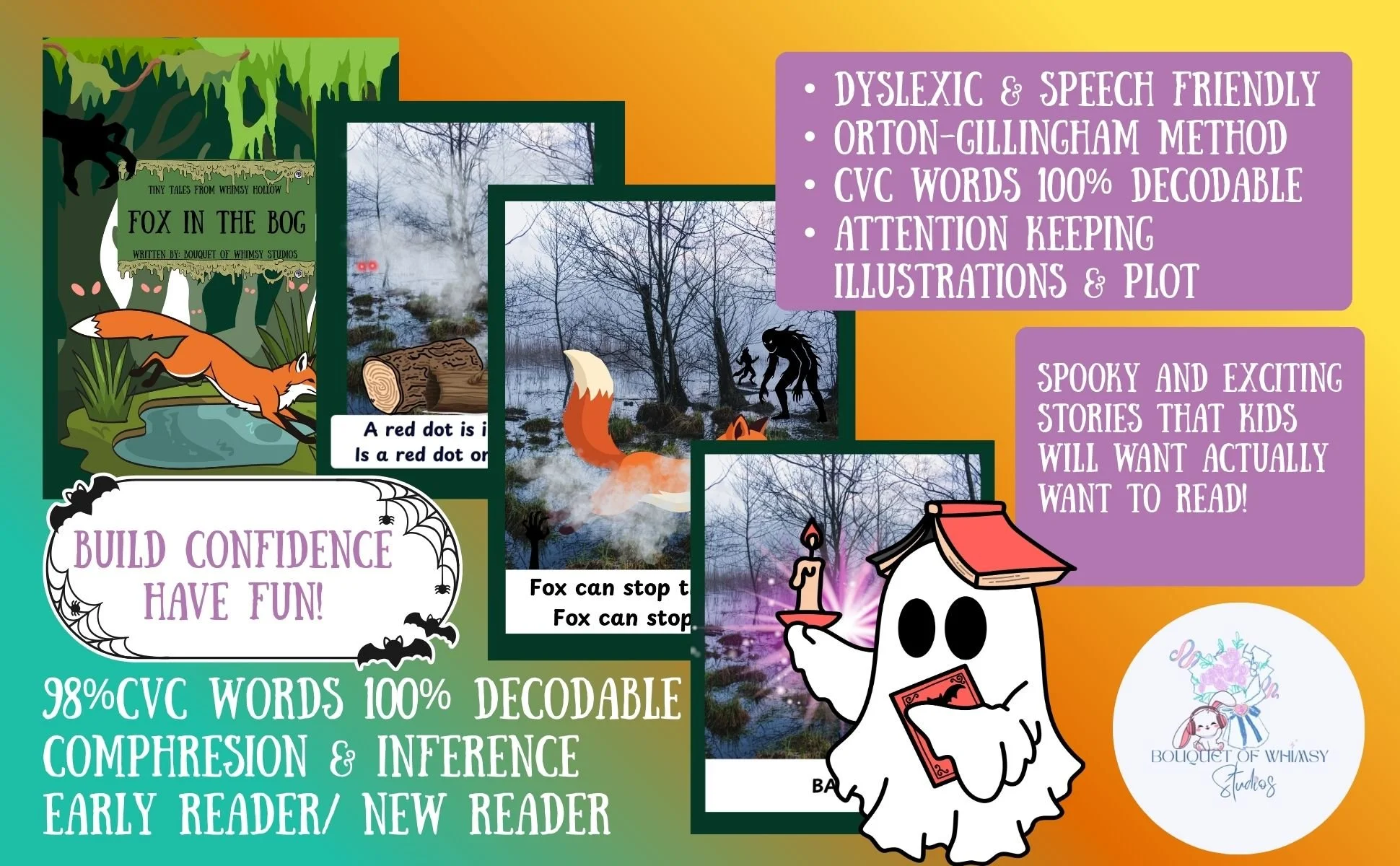
Engineered for High-Success: By relying strictly on CVC words, realistic CVCC words, and basic blends, these books systematically lower the cognitive load. They provide a steady stream of "easy" wins that fire the synapses, paving the neural highway and flooding the brain with motivational dopamine.
Fast-Paced Thrillers (No Boring Drills): While the mechanics are strictly controlled for success, the stories are anything but sterile. They are atmospheric, moody, fast-paced mysteries. The spooky illustrations and clever plots activate a natural "research mode," where kids want to decode the text because they are genuinely desperate to solve the mystery and make subtle inferences about the plot.
100% Human-Authored: In a world full of artificial, machine-generated filler, these books are created entirely by a human, for humans, with zero AI. Every line is intentionally crafted by an author who understands how to balance deep psychological engagement with rigid phonetic rules.
Take Back the Narrative
An email from a school stating your child is behind isn't a life sentence—and a wall of polite institutional deflection isn't a dead end. It is simply a sign that the classroom's current methods are causing a neurological traffic jam.
You can break the gridlock tonight. Step away from the guessing games, shut out the defensive noise, and lean into the beautiful, proven science of simple, decodable text. By celebrating the massive biological victories of the "easy" words in Whimsy Hollow, you will rebuild your child's reading brain—and their confidence—page by page.
Have you ever noticed the tension shift when asking for specific reading data at school? How do you navigate the balance between classroom assignments and what you know your child needs at home? Let's swap notes in the comments below!