How To Help A Child Read When Your School Is Being Useless
Reignite the Love of Reading: Why "Tiny Tales from Whimsy Hollow" is the Spark Reluctant Readers Need
The email arrives on a Tuesday afternoon. It’s brief, polite, and completely paralyzing.
“Just a quick update: Your child is currently trailing behind peer benchmarks in reading fluency. We are working on it in class, but please make sure you are reading together for 20 minutes every night at home!”
You stare at the screen, a knot forming in your stomach. No breakdown of why they are behind. No mention of specific phonetic gaps. No actionable roadmap. Just a vague warning and a directive to "read more"—which, at this point, feels like being told to fix a broken car engine by just turning the key harder. Oh, and let’s not forget the gaslighting taking place… Sure you send your child to school but the reading with you at night is why they can’t read right? You’re the problem? Not the masters holding educator that is supposed to be helping your child read in the seven hours per day they have them right?
You know exactly what that 20-minute nightly mandate actually looks like: tears, avoidance, and a brutal battle over a book that feels like a wall of impossible hieroglyphics. And it feels cringe and abusive right? Well, honestly because it is. American educators are burdening parents and families with unfair expectations and an illusion that they have done their part as educators. I can assure you- in most cases, they have not.
If this scenario sounds familiar, you aren't alone. You are living on the front lines of a quiet national emergency.
When schools fail to provide explicit, structured strategies, parents have to become the advocates and the architects of their children's literacy. If you are looking for the precise tools to break the cycle of frustration, the Tiny Tales from Whimsy Hollow series by Bouquet of Whimsy Studios—featuring titles like The Hag’s Pot, Fox in the Bog, The Red Bag, and The Hut—is exactly what you've been searching for.
1. The Backdrop: America’s Literacy Crisis and the "Just Read" Fallacy
To understand why a vague "just read more at home" directive is so unhelpful, we have to look at the broader landscape of American education. According to data from the National Assessment of Educational Progress (NAEP)—often called the Nation’s Report Card—the U.S. is facing a massive literacy crisis, with a staggering percentage of elementary students performing below basic proficiency levels.
For decades, many classrooms drifted away from systematic phonics instruction, favoring outdated "whole language" or "balanced literacy" models that encourage kids to guess words based on pictures or context clues. When a child falls behind under these methods, simply handing them a standard storybook and telling them to "practice" doesn't work. It actually cements bad habits.
If a child hasn't mastered the fundamental code of the English language, handing them a random book is an exercise in futility. They don't need more text; they need decodable text. They need books that respect the rules of phonics.
2. Behind the Science: The Neuro-Mechanics of Reading
When a school doesn't offer a strategy, neuroscience does. Let’s peak behind the curtain to see exactly what happens upstairs when a child cracks open a highly structured book from this series.
The Battle of Cognitive Load
Parent: Why does my child get so exhausted after just ten minutes of trying to read a standard storybook?
The Brain: Because of cognitive load. Working memory is like a tiny bucket. When a beginner encounters a page full of unpredictable words, irregular spellings, and complex multi-syllable traps, that bucket overflows instantly. The brain spends 100% of its energy simply trying to decode the mechanics of the letters. By the time they reach the end of the sentence, they have zero mental bandwidth left to actually comprehend what they just read.
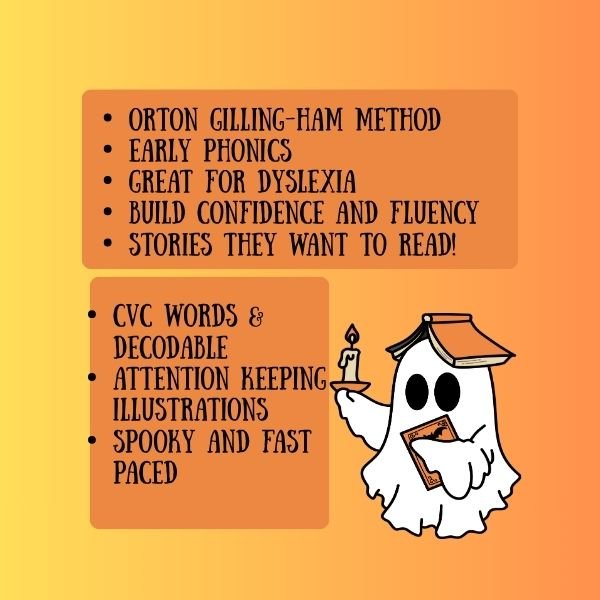
How Whimsy Hollow Fixes It: Every title in the series is a masterclass in controlled cognitive load. By relying strictly on CVC words (pot, hag, bog, hut), realistic CVCC words (melt, fast, hand), and easy consonant blends, the series narrows the linguistic rules. The "bucket" doesn't overflow. Decoding becomes lightning-fast, freeing up immediate mental space for actual comprehension.
Firing and Wiring the Synapses
Parent: How do we move them from painfully sounding out every single letter to just "knowing" the words smoothly?
The Brain: It’s all about building neural pathways. Reading is not a natural human instinct; the brain has to literally rewire itself by connecting the visual cortex (seeing letters) with the auditory cortex (hearing sounds). Every time a child successfully decodes a word, a synapse fires, releasing neurotransmitters that strengthen that specific neural bridge. Repetition is key, but it has to be successful repetition. If a child repeatedly guesses incorrectly or gets frustrated, those vital pathways don't form.
How Whimsy Hollow Fixes It: Because titles like The Red Bag and Fox in the Bog are engineered for an incredibly high success rate, your child triggers positive, successful synaptic firings over and over again. It’s the neurological equivalent of paving a dirt road into a smooth highway. The more they encounter these reliable phonics patterns in a safe, predictable environment, the faster those word-recognition pathways become permanent.
3. Fast-Paced Thrillers for First Graders: Spooky Magic & Organic Comprehension
Let’s be honest: a lot of early reader books are entirely sterile. "The cat sat on the mat" provides zero cognitive reward. The brain gets bored, dopamine drops, and the child disengages.
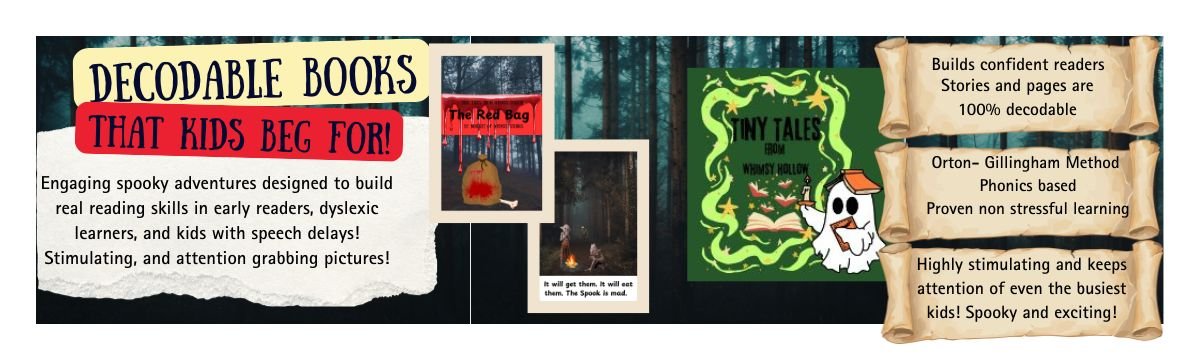
Tiny Tales from Whimsy Hollowflips the script by delivering fast-paced thrillers and atmospheric mysteries disguised as early readers. The stories lean into a beautifully moody, "dark whimsy" aesthetic—think intense, glowing green cauldrons in The Hag's Pot, misty mysteries inFox in the Bog, secrets hidden within The Hut, and the compelling urge to find out what is inside The Red Bag. The striking, spooky illustrations and cinematic pacing keep visual learners anchored and entirely captivated.
Activating "Research Mode" and Deep Comprehension
Because these stories are genuinely gripping, they do something brilliant: they build advanced comprehension skills completely organically.
Instead of asking dry, artificial quiz questions at the end, these books plant subtle text and visual inferences. Your child will naturally begin asking questions: Why is the bag red? What is the hag brewing? What is hiding in the hut? This activates a highly engaged "research mode" in young readers. They begin treating the book like a mystery to be solved, scanning the text for clues, predicting outcomes, and making critical connections. They aren't just decoding letters anymore; they are practicing high-level, critical reading comprehension because they are genuinely desperate to know what happens next.
The Ultimate Guarantee: Created by a Human, for Humans
In a world increasingly flooded with sterile, machine-generated content, there is one final, vital element that sets this series apart: These books are created entirely by a human, for humans, with absolutely zero AI. Every single sentence has been intentionally crafted by an author who understands the fragile mechanics of a child's developing brain. Every vivid illustration is infused with real artistic soul, depth, and intentional dramatic tension that no algorithm could ever replicate. Children can sense the difference between artificial filler and a story told with real passion—and Whimsy Hollow resonates because it has a heartbeat.
The Verdict: Smart Mechanics Meet Dark Whimsy
When the school system leaves you floating without a paddle, the best advocacy tool you have is targeted, high-quality literature at home. The secret to raising a reader isn’t forcing them through frustratingly complex books to hit a vague benchmark; it’s giving them the right books that respect their neurological limits while feeding their imagination.
Tiny Tales from Whimsy Hollow hands the power back to the parents, turning defensive nighttime reading battles into a triumphant, magical march toward fluency.
Have you ever received one of those vague "behind-benchmark" emails from school? Which Whimsy Hollow title do you think would capture your child's imagination first? Let’s talk about it in the comments below!