The History of Jumping Jack Toys: 18th Century Pantin Automata
The Field Researcher’s Chronicle: The Accidental Magic of the First Automata—The Strange, Hypnotic Reign of the Jumping Jack
History has a fascinating way of turning miracles into toys. Long before we had robots, algorithms, or digital screens competing for our neural real estate, humanity was deeply, unnervingly obsessed with a different kind of sorcery: making dead matter move.
Today, we open the archive to look at a point in the 18th century where high philosophy, clockwork engineering, and pure street-level madness collided to create the world’s first mass-produced mechanical anomaly: the Jumping Jack puppet.
Pull up a chair, light a candle, and let us dissect the accidental magic of the Pantin.

The Enlightenment, Miracles, and the Spark of Life
To understand why a flat, jointed doll with a pull-string caused an absolute societal meltdown, you have to look at the atmosphere of the mid-1700s. Europe was in the grip of the Enlightenment. Clockmakers and horologists were the tech gods of their day, using coiled tempered steel, gears, and brass pulleys to create jaw-dropping, life-sized automata.
This was the era of Jacques de Vaucanson’s famous mechanical flautist and his legendary, golden-copper "Digesting Duck" that pecked grain and realistically defecated on a silver platter. Philosophers like Voltaire and Julien Offray de La Mettrie watched these clockwork wonders and wondered: Is the human body just a more complex machine? Can we simulate the soul through physics?
It was a profound, deeply high-concept existential crisis. And then, as human culture always does, someone took that massive philosophical question and shrunk it down into a cheap, brilliantly chaotic street-level artifact.
The Paris Explosion: The Mania of the Pantin
Around 1747, a simplified, two-dimensional version of these great mechanical dolls burst onto the streets of Paris. The French called it a Pantin (the Dancing-Jack).
The architecture of a Jumping Jack is deceptively simple but texturally brilliant. It relies on a single plane, using the physical principle of the lever. The arms and legs are loosely jointed to a central cardboard or wooden torso, with all the moving parts bound hidden behind the frame to a single, central pull-string hanging from the bottom. One sharp tug down, and the limbs snap upward in a uniform, defiant jerk.
What happened next was an absolute "WTF" moment in pop-culture history. The Pantin didn't start as a children's toy. It became a raging, unhinged obsession for the adult aristocracy.
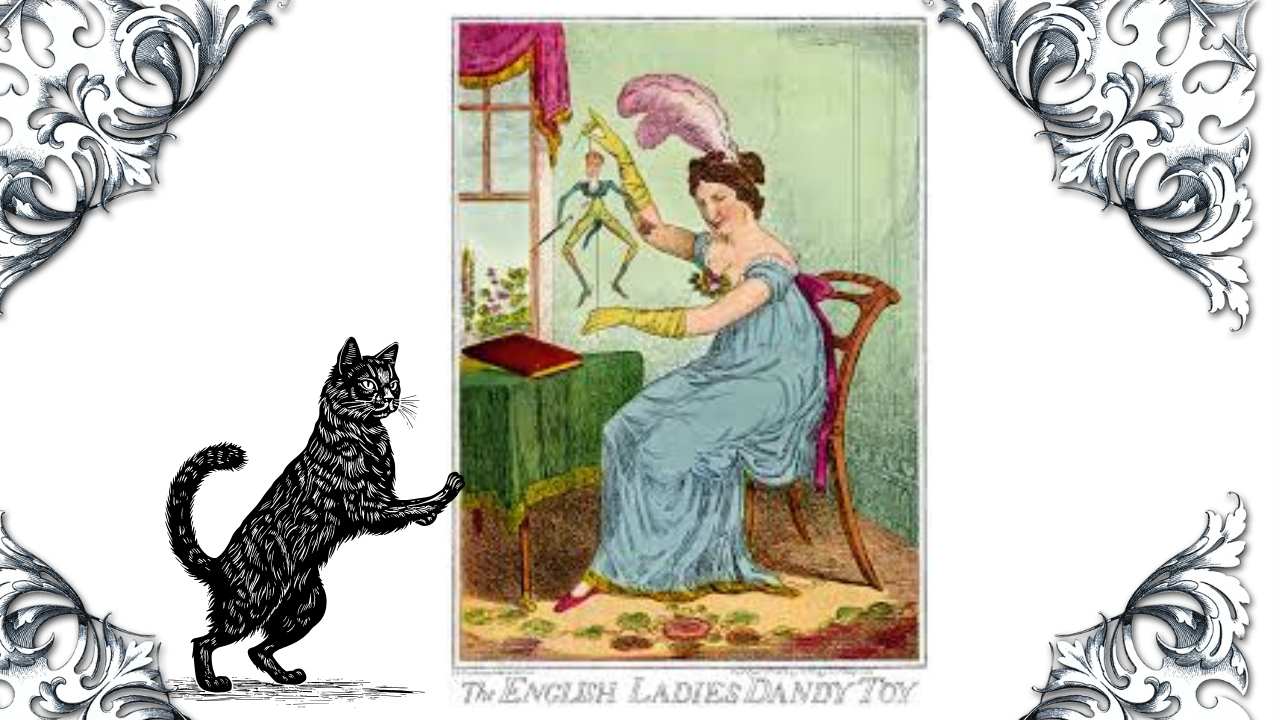
The famous chronicler Edmond Barbier wrote in 1747 that "one cannot go into any house without finding a pantin hanging by the mantelpiece." The philosopher D'Alembert noted with a mix of amusement and horror that across Paris—in the salons, at court, on public promenades—elderly men and high-society women were pulling these jointed figures from their pockets and pulling the strings "in the most serious manner in the world." Wealthy nobles commissioned famous painters like François Boucher to hand-paint their custom dolls, with the Duchess of Chartres famously spending an astronomical 1,500 livres on a single piece. They were painted as Commedia dell'arte characters (like Pierrot or Polichinelle), libertines, and vicious political caricatures.
The "Accidental Magic" of the Jerk
Why did the smartest minds of the 18th century stand around pulling strings to make cardboard legs flap? Because of a cognitive phenomenon we might call accidental magic.
When an adult operates a traditional puppet, there is a fluid, human-directed intentionality to the movement. But the Jumping Jack introduces a jarring kinetic disjunction. You pull down, and the limbs snap up. The movement is jagged, instantaneous, and completely detached from natural human grace. It mimics the "fast cuts" and high-stimulation visual jumps that capture our primal attention.
To the 18th-century mind, watching a flat piece of paper instantly defy gravity with a singular mechanical snap felt like an eerie, hilarious simulation of life. It was a pocket-sized version of the great automata—a way for an ordinary person to play God over a tiny, twitching courtier or politician.
The Metamorphosis: From Royal Salon to the Squeeze Toy
As the 18th century rolled into the 19th, the elite mania faded, and the Jumping Jack underwent a class mutation. Mass-production imagerie workshops—most notably the Pellerin firm in Épinal, France—began printing cheap, colorful lithograph sheets of these dolls.
Working-class families and peddlers bought these sheets for a few sous, pasted them onto scrap cardboard, cut them out, and strung them together at the hearth. In Germany, the toy became known as the Hampelmann, evolving into a traditional wooden folk art caricature crafted in the Ore Mountains. In Britain, it earned the delightfully bizarre linguistic title of the Quockerwodger—a term so evocative of a string-pulled puppet that 19th-century citizens began using it as a derogatory insult for politicians whose strings were entirely controlled by hidden puppetmasters.

The Field Verdict
The Jumping Jack is a vital milestone in our study of dark whimsy and high-stimulation artifacts. Long before the digital native generation was searching for instant cognitive rewards on glass rectangles, their ancestors were standing in candlelit French drawing rooms, getting a quick, satisfying hit of dopamine from the frantic, mechanical twitch of a cardboard doll.
It proves that humanity’s desire to be mesmerized by the artificial, the automated, and the slightly uncanny isn't a modern affliction. We have always been obsessed with the strings.