The Curious Alchemy of New England’s Weirdest Tradition: A Field Report on Grape-Nut Ice Cream

There is a unique, cozy magic in the way New Englanders preserve things. Step off the winding, moss-draped coastal backroads, step over the knee high stone wall and meander across the meadow. Turn right at the Gull and Goat Coffee shop, and into any generational seaside dairy bar, and you will find an anomaly sitting quietly in the freezing tubs, nestled right between classic vanilla bean and dark chocolate, and maybe three down from toasted coconut. If you get to the black raspberry, or maple walnut- you’ve gone to far.
And there it glistens and swoons. It is a flavor that defies the modern law of ice cream physics. It isn’t smooth, but it isn’t not smooth, it isn’t brightly colored, and its name is a complete lie.
Welcome to the strange, romantic history of Grape-Nut ice cream—a regional culinary anomaly that tastes less like a modern dessert and more like an edible artifact from a forgotten era. For the sentimental souls, the cozy fantasy readers, and the culinary historians, this is the definitive deep dive into the northeast's most whimsical frozen secret.
The Lie of the Grape and the Nut: A Brief History
To understand the whimsy of Grape-Nut ice cream, one must first understand the bizarre history of its central ingredient.
Invented in 1897 by C.W. Post, Grape-Nuts cereal contains absolutely no grapes and absolutely no nuts. It is crafted from a dense, malted batter of wheat and barley that is baked into giant, rock-hard sheets, broken down into tiny, gravel-like nuggets, and roasted again. In its dry state, it possesses a texture that could rival the cobblestones of an ancient village square.
The magic happened a few decades later, just across the border in Canada, before sweeping down into the coastal towns of Maine, Massachusetts, and New Hampshire. According to folklore, a creative chef named Hannah Young ran out of fresh fruit to flavor her ice cream during a long, isolated winter. Looking through her pantry, she threw a handful of the stubborn, crunchy cereal into a fresh batch of sweet cream custard.
What should have been a dental disaster turned into a revelation.
The Taste: An Alchemical Transformation

If you have never experienced it, the texture of Grape-Nut ice cream sounds like a contradiction. However, the true wizardry occurs during the churning process.
When the rock-hard malted nuggets are submerged into the cold, velvety expanse of sweet cream, they don't disintegrate into mush. Instead, they absorb the liquid cream like tiny, porous stones.
The Texture: The cereal softens into a dense, chewy, almost cake-like texture. It feels remarkably like tiny pockets of brown sugar cookie dough scattered throughout a frozen custard.
The Flavor Profile: The base is typically a rich, old-fashioned vanilla or a deeply comforting, burnt-sugar maple. The malted barley and wheat from the cereal infuse the ice cream with a deeply toasted, nutty, and caramelized depth.
It tastes exactly like a rainy autumn afternoon spent inside a dusty, candlelit library. It is heavy, sentimental, and deeply grounding.
The Bestiary: Which Fantasy Creature Loves It Best?
If the researchers at the Whimsy Hollow Library were to document the fae and magical creatures drawn to this specific flavor profile, they would undoubtedly point their quills toward the Brownies and Hearth Sprites.
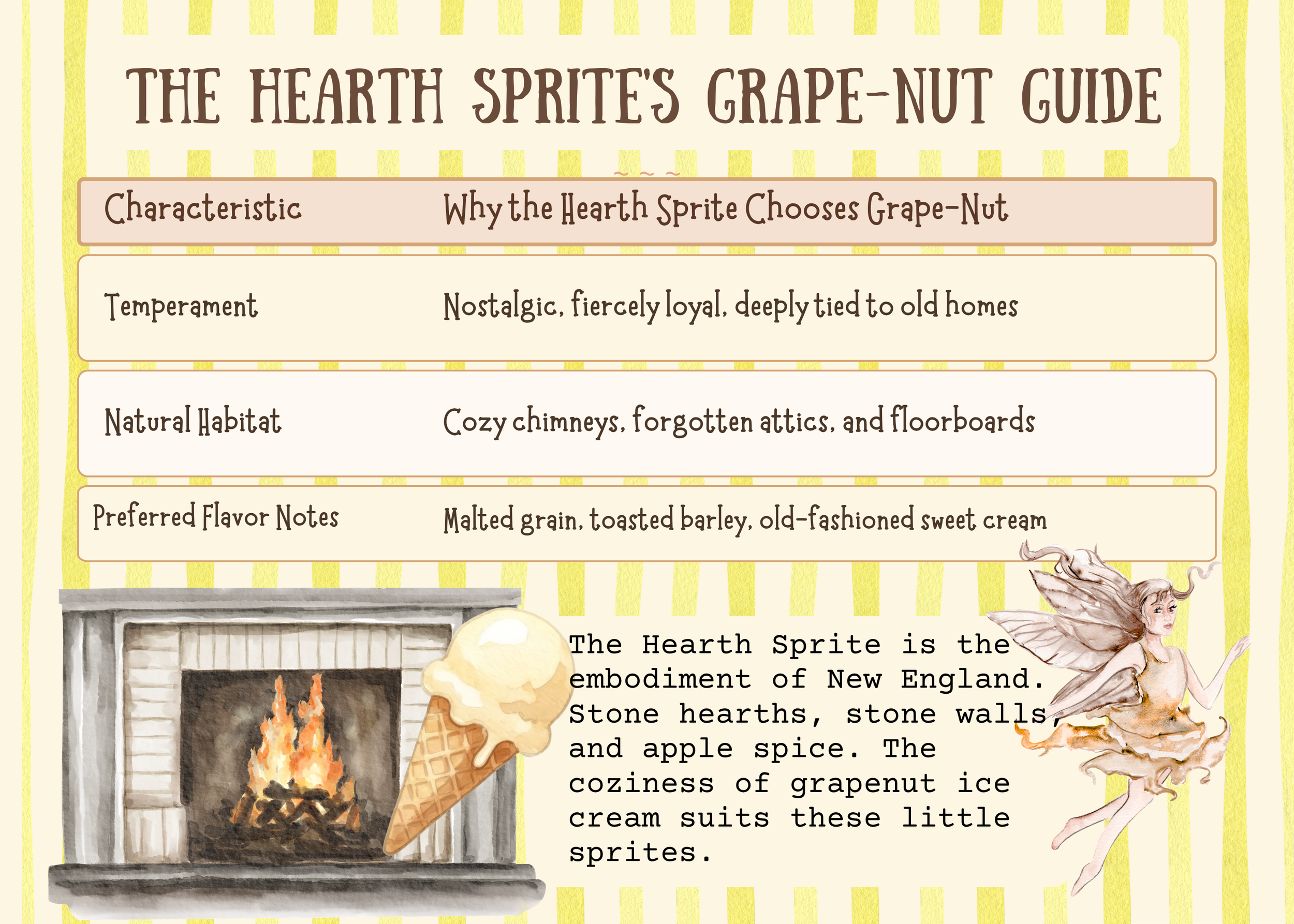
Why the Hearth Sprite?
Hearth Sprites do not care for the flashy, neon-colored sorbets of the summer sprites, nor do they seek the intense, bitter chocolates favored by mountain trolls. They are sentimental creatures of comfort. Because Grape-Nut ice cream relies on a pantry staple originally meant to sustain families through harsh, dark winters, it carries the literal essence of home preservation.
A Hearth Sprite would gladly trade a hidden copper coin or a perfectly mended sock for a small wooden spoon dipped in maple Grape-Nut. To them, the toasted grain notes taste like a roaring fire on a freezing night.
How to Romanticize Your Ice Cream Ritual
If you are lucky enough to find yourself at a roadside dairy stand in the heart of New England, or if you are brave enough to churn a vintage batch in your own kitchen archive, treat the experience as an act of historical preservation.
Don't rush the scoop. Enjoy it out of a heavy ceramic bowl, perhaps paired with a strong, bitter black tea to cut through the rich sweetness of the malt. It is the perfect companion for an evening spent diving into sun-bleached dread or a stack of gothic novels.